One of the major knocks on the electric vehicle revolution is that batteries pose a massive environmental problem, because of how their ingredients are sourced and how they are disposed of at the end of their life. To counter this, the cleantech sector is vying to spin up modern, efficient battery recycling to break down old batteries and pull out the materials to build new ones.
Over the past few years, the outlines of a domestic battery recycling industry have started to take shape. A cadre of new startups raised a few billion dollars based on promises of recycling breakthroughs that improve on legacy techniques, like pyrometallurgy and hydrometallurgy. The country’s first new-wave battery recycling facilities have opened up and begun operating, and more are under construction.
But 2024 has brought a series of disappointments for the emerging industry, including stalled construction projects, reduced expectations for what new recycling technologies can actually deliver, canceled projects, layoffs, and a catastrophic fire.
Beyond company-specific setbacks, the sector as a whole has struggled with a collapse in the price of several key battery commodities, namely lithium, nickel, and cobalt. Recyclers want to sell their metal outputs for more than it cost them to recycle; they succeed if they become a cheaper source of metals than mining. That’s easier to pull off when prices soar like they did in 2022, but the drop in prices, while delightful for battery manufacturers and customers, scrambled the economics for recyclers.
The U.S. has so far been able to ramp up capacity to break down old battery packs and shred the key components into a fine, mineral-laden powder called black mass. Battery cell manufacturing has blossomed as well — the U.S. is set to produce 1.2 terawatt-hours of battery capacity by 2030, per a Benchmark Minerals analysis of the Inflation Reduction Act’s impact (which could be subject to change under the next administration). But that leaves a critical gap in U.S. recycling capabilities.
“The steps in between those two are lagging behind,” noted David Regan, vice president of commercial at Aqua Metals, a recycling startup based in Reno, Nevada. In short, the country still mostly lacks the means to isolate the useful materials in the black mass it’s producing and refine them into what the industry calls PCAM, or precursor cathode active materials, which then get turned into new battery cathodes.
A few instances of incremental progress stand out against that dour backdrop. Startup Ascend Elements has installed a line to produce lithium carbonate at its battery disassembly facility in Covington, Georgia, for example, marking the first new production of that product in the U.S. in decades. Commissioning is wrapping up now, after which the company expects to produce 3,000 metric tons per year, co-founder and Chief Technical Officer Eric Gratz told Canary Media in an exclusive interview.
The previous source of domestic lithium carbonate was an Albemarle refinery in Nevada, where that company extracts lithium from brine. Ascend’s new addition will mark the first recycled lithium carbonate to hit the market in the country. Ascend will sell the technical-grade substance to an unnamed customer who will refine it to battery-grade purity.
The fact that this breakthrough is happening in early 2025, however, speaks to the limits of U.S. lithium-ion battery recycling thus far.
Bad news: Fire, factory delays, paring back ambitions
In the meantime, the list of battery recycling setbacks has grown long.
Most dramatically, in late October, a fire destroyed what used to be the nation’s largest battery breakdown operation. The conflagration at Interco’s Critical Mineral Recovery facility, 90 miles south of St. Louis, prompted authorities to issue evacuation orders for nearby residents threatened by toxic smoke and shelter-in-place orders elsewhere. It took firefighters two weeks to officially extinguish the fire, at which point the wrecked facility was slated for demolition. It was not immediately clear what ignited the blaze, but grinding up batteries carries a fire risk, and stockpiles of damaged or old batteries can easily become fuel for a burn.
That devastation took out a complex that used to break down 60,000 tons of batteries a year.
Other mishaps have been slower burns. Li-Cycle paused construction of its Rochester, New York, facility one year ago, citing cost overruns with its local contractors. That work remains on hold, and in the meantime Li-Cycle has reduced its ambitions for the plant in the hopes of finishing construction and shipping products sooner.
Li-Cycle originally envisioned Rochester as the place it would send the black mass it ground up at other locations, then process it with hydrometallurgy techniques to pull out all the useful battery materials. Under the revised plan, the firm will isolate 8,250 metric tons of battery-grade lithium carbonate, and also sell up to 72,000 metric tons of the remaining powders, which contain nickel and cobalt and are known as “mixed hydroxide precipitate” (MHP). That product requires further refining before it is usable as a battery material. Li-Cycle investor and global mining giant Glencore has agreed to buy all the MHP that comes out of Rochester.
Li-Cycle CEO Ajay Kochhar framed this as a good first objective to get revenue rolling at the plant.
“This mixed product of nickel and cobalt is cheaper to get to, and you get paid pretty well for it,” he told Canary Media in November.
Li-Cycle has stayed alive through the construction delay, but in doing so has pushed back the timeline for full-fledged battery recycling.
“All these [recycling] companies, we’re all commodity-exposed and we’re at cyclical lows for cobalt, nickel’s taken a beating,” Kochhar said. “You’ve got to learn how to run lean, and know when to grow.”
Ascend, too, has delayed the opening of its flagship Apex facility in Kentucky, although for different reasons.
The company plans to send the black mass it breaks down in Georgia to be refined at its forthcoming Apex site in Kentucky. But the buyer Ascend secured for those battery materials ultimately pushed back the start date for the contract in response to softening EV demand. Ascend used that opportunity to pause construction and renegotiate a contract for a more leisurely and economical pace of completion. The new plan is to start PCAM production there by the end of 2025.
Ascend also had a shakeup on its roster of equity owners. SK Ecoplant, a subsidiary of the Korean battery giant, at one point held the most shares in Ascend, but decided to cash out earlier this year. Generally, when a leading investor wants out, it’s not a favorable sign.
In this case, though, SK Ecoplant did turn a profit: It bought in for $61 million and sold its stake for $98 million. A spokesperson for Ascend noted that the move followed a major restructuring at Ecoplant, which turned its focus away from battery recycling. That also led to the dissolution of a previously announced battery-shredding joint venture between the companies.
Aqua Metals, which is pursuing a less resource-intensive means of separating valuable battery materials, ran into financial trouble this year as it sought financing for its first commercial-scale recycling complex, in Reno. The company secured a credit facility from a private lender, but in the course of a few months of due diligence, lithium prices dropped so much that the business plan to pay back the credit fell apart. Aqua Metals responded by laying off staff and reducing other expenses, in hopes of stretching its resources to a year of cash runway, per an August filing.
Good news for Ascend
That succession of delays and disappointments makes Ascend’s new lithium carbonate line stand out as a rare bright spot.
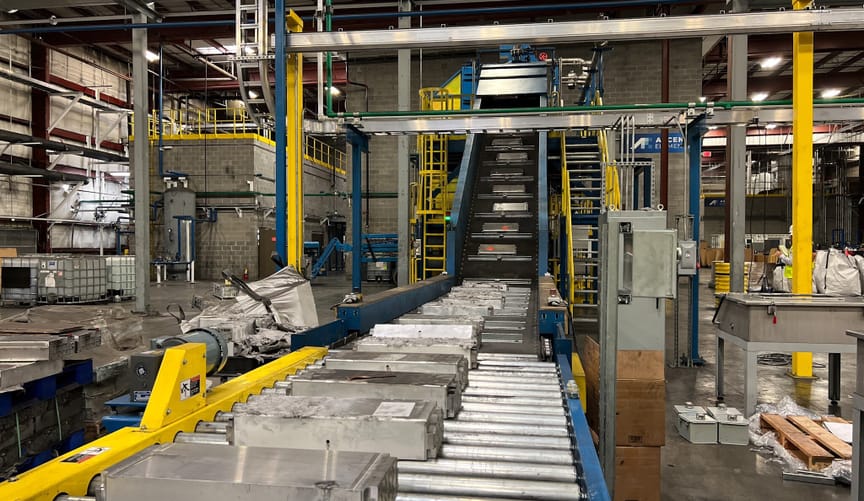
The company opened its Covington plant in August 2022 to break down 30,000 metric tons of battery packs annually. The facility pulls out the metal bits in the packaging, then grinds battery components into black mass. Now, in an adjacent room to the cavernous hall of battery deconstruction, Ascend has installed a series of floor-to-ceiling tanks covering about 30,000 square feet.